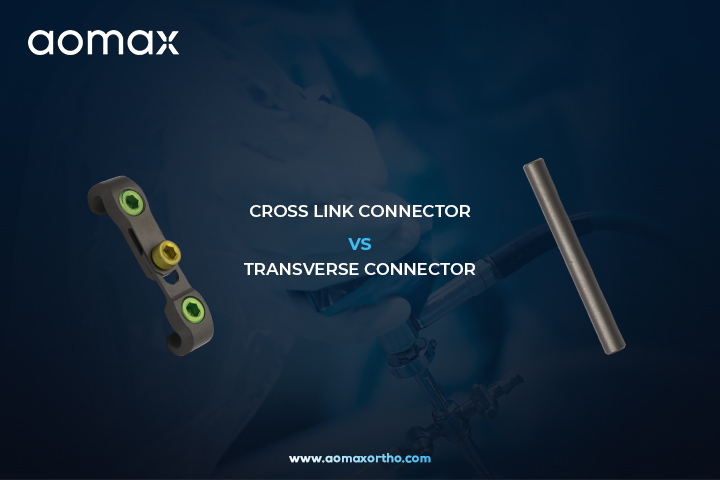
In posterior spinal fusion surgeries, cross-connectors are essential for linking bilateral rods, enhancing torsional stability, and reducing rod migration or parallel displacement. Two common options are the Cross Link Connector (Top Loading) and the Transverse Connector (Flat Rod). While both improve construct rigidity in thoracolumbar or cervical procedures, they differ in design, surgical application, and performance.
Design & Compatibility
The Top Loading Cross Link Connector features a pre-assembled or simple clamp design that loads directly onto standard round spinal rods (typically 5.5–6.0 mm) from above. It uses set screws for secure fixation and comes in adjustable lengths (e.g., 30–100 mm). Its titanium construction offers low profile and multi-axial adjustability in some systems.
In contrast, the Transverse Connector (Flat Rod) uses a flat connecting rod (often 4.0 mm) or interfaces with flat-profile elements. It connects rods or plates via side/front loading and is ideal for systems requiring rectangular bars or custom contouring. This design distributes stress differently and suits tighter anatomical spaces.
Surgical Ease & Stability
Top Loading excels in intraoperative efficiency: surgeons drop it onto rods after rod placement, minimizing tissue disruption and assembly time. It provides excellent anti-rotation strength with minimal ROM reduction in axial rotation.
Flat Rod Transverse offers superior contourability and a lower profile for complex deformities or revisions. It enhances rigidity in cervical constructs but may require more precise rod preparation.
Key Advantages
| Feature | Top Loading Cross Link | Flat Rod Transverse Connector |
|---|---|---|
| Loading | Top (fast, easy) | Side/Front (custom fit) |
| Rod Type | Round rods | Flat rods/bars |
| Best For | Standard fusions, speed | Deformities, low-profile needs |
| Stability Focus | Torsional (axial rotation) | Multi-plane + contouring |
Both reduce motion effectively, but clinical studies show the added benefit is often modest in single-level cases—choose based on patient anatomy and surgeon preference.
Conclusion: Select Top Loading for quick, reliable stabilization in routine cases. Opt for Flat Rod Transverse when contouring or profile matters most. Consult your implant system specs for optimal fusion outcomes. Always prioritize biomechanical needs for long-term success.
Get Connected:
+91 98989 50530 | ortho@advinhealthcare.com | www.advinortho.com